Showing posts with label biomechanics. Show all posts

Monday, November 30, 2015

Spinosaurus: the Giant of North Africa


Spinosaurus aegyptiacus is one of the most extraordinary animals to have ever existed. It is the largest theropod dinosaur, substantial bigger than the famous T. rex. This also makes it bigger than any terrestial predators that ever walked the earth. Today the biggest predators on land are big cats and bears; the largest herbivores are elephants. Yesterday, the biggest predators were bigger than elephants and their prey was even bigger than that! The anatomy of Spinosaurus is one of the most unique among dinosaurs, as if size wasn't enough. It also is one of the most controversial dinosaurs ever, which is a consequence of being one of the most mysterious dinosaurs ever. In the past hundred years since its first discovery, only a handful specimens have been found. This is something because Spinosaurus teeth is frequently found in North Africa.

The life after death of Spinosaurus is also amazing. It is an interesting story involving adventure in one of the most hostile environments in Africa and even on earth, Germany, and the Nazis. The story continues today with a most extrordinary discovery that has lead to more questions than answers. The story of Spinosaurus is not over. It has left us at a cliff-hanger.

In 1912, a friend of German paleontologist Ernst Stromer, while working for him, discovered what would be one of the most enigmatic and fascinating dinosaur ever. The remains were found in the deserts of Egypt. Stromer was not used to the heat and primitive conditions of Africa and he found the exploration difficult but he continued work there and visited Africa often. His efforts were not in vain. He went to Egypt originally to find mammals but soon found large dinosaur material, including Spinosaurus. The Spinosaurus specimen was scrappy, consisting of a few vertebrae and a partial lower jaw. The few remains that Stromer had revealed that the animal that it came from was like no other animal known. It was definitely huge, the lower jaw measuring more than 3/4 of a meter. It was also of unusual shape, being long and narrow with a bulbous anterior end. The vertebrae were unusual as well, having enlarged neural arches up to 2 meters tall. The series of vertebrae with these exaggerated neural spines would have created a sail along the animal's back, similar to what is found on the synapsids Dimetrodon and Edaphosaurus or even a hump like that of buffalo. Due to this unusual vertebrae morphology and because of the locality that it was found Ernst Stromer decided to call this animal Spinosaurus aegyptiacus. The type specimen of Spinosaurus aegyptiacus was housed and put on displayed in a museum in Munich along with many other treasures that was discovered by Stromer and his colleagues in northern Africa.
How Spinosaurus was originally imagined to be. Note how it appears to be more like an Allosaur like animal instead of how we know it today.

Ernest Stromer
Thankfully, Ernest Stromer was very diligent in describing this new animal and making exhaustive figures and photographs of his material because in April 1944, during World War II, the museum and all that it housed was destroyed in a bombing raid by the Allies. It was a terrible loss for Stromer, who also lost two of his three sons in the war, and is one of the most unfortunate losses in all of paleontology and even all science. The curator of the museum was fiercely loyal to the Nazis who were in power at that time and refused to bring the museum's collection to safety despite repeated warnings of the possibility of the museum being destroyed and still refused even after Stromer, being an anti-Nazi himself, repeatedly requested that his collections to be brought to safety. However any action of the sort was seen as a breach of loyalty by the curator and it would be better that the whole museum be destroyed than for the Nazis to suffer defeat. Both happened however and for years scientist had to rely on Stromer's descriptions, figures, and photographs to understand and reconstruct a very puzzling dinosaur.


Ernest Stromer's original material.

Since 1944, additional material that has been prescribed to Spinosaurus has been found, mostly from the Kem Kem beds of Morocco. The findings do not disappoint! It is widely accepted that Spinosaurus was the largest theropod dinosaur that ever existed which also would make it the largest predator to ever walk the earth. Other animals have been found around the world that were very similar to Spinosaurus though none have been close to reaching its body size and the extreme proportions of its dorsal spine.

One of my favorite reconstruction of Spinosaurus appeared in the BBC
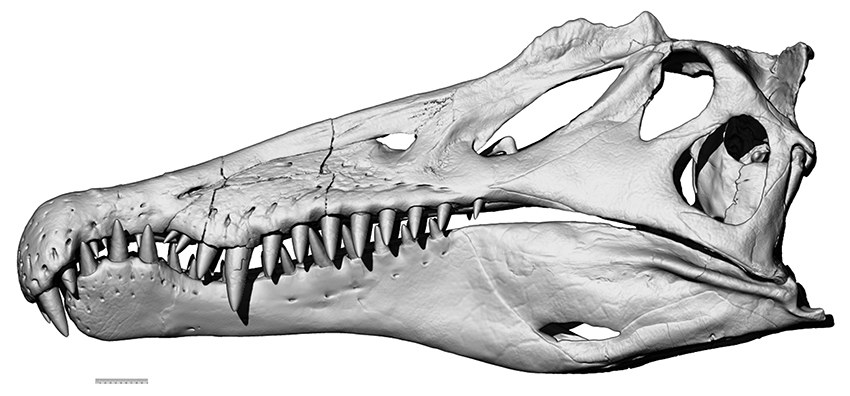
Due to the destruction of the type specimen and the absence of other specimens, many inaccurate reconstructions were made throughout history. Because most familiar theropod dinosaurs at that time of Stromer's expeditions were allosaurs and tyrranosaurs, which all had tall, narrow, and short skulls, Spinosaurus was reconstructed as an allosaur-like animal with a dimetrodon type sail. Despite the bottom jaw that was well figured and photographed indicating that was a very unique animal, different from anything that was known before. The error continued in pop reconstruction of Spinosaurus even after other spinosaurs were found and additional Spinosaurus material was found showing just how unique spinosaurs were. But that all changed after Jurassic Park III hit theaters in 2001, starring a rampaging Spinosaurus that slaughtered the great T. rex and had its life goal to make a few humans' lives miserable. That movie, particularly the scene where T. rex was killed, I must confess, helped fuel my fascination with Spinosaurus. The Spinosaurus in that movie had a skull that was pretty close to what is actually known to be the correct shape of Spinosaurus' skull. That helped expose the public to a more accurate reconstruction of Spinosaurus' skull morphology and inaccurate depictions of Spinosaurus as an allosaur soon died out.
Spinosaurus

A skeletal drawing of Spinosaurus by Scott Hartman
 

Spinosaurus is often compared to a crocodile and recently, it has even been compared to a sea cow. The crocodile analogy is somewhat appropriate. Spinosaurus  was definitely semi-aquatic. Oxygen isotopes indicate that Spinosaurus was possibly as aquatic as crocodylians and turtles. Spinosaurus could have spent most of its life in and around water, hunting fish. They possibly even escaped to the water to help control their body temperature like modern hippos and crocodylians.

Somewhat recently found material of Spinosaurus.
Spinosaurus is without a doubt one of the largest if not the largest theropods to ever walk the earth.
Estimates put Spinosaurus at a length of 15 meters. That is much larger than the largest tyrannosaur and even larger than the Carcharodontosaurus that Spinosaurus would have lived with. Spinosaurus would have appeared much bigger with the huge sail sticking out of its back as well.

 The world that Spinosaurus would have lived in was very unique and not like anything that we would be familiar with at all.

The environments that Spinosuarus has been found were probably freshwater/brackish marshes and deltas in the past. They probably lived close to where large rivers met the sea. Based on that conclusion I would think that it would fair to say that Spinosaurus lived in and around freshwater, brackish,and marine environments. There has not been any fossil evidence to support the idea that Spinosaurus may have traveled into the sea but modern crocodylians do it quite extensively. I think that it would have been possible if Spinosaurus had done the same, if not, at least hugging the coastline.

The animals that Spinosaurus would have primarily preyed upon would have been fish. The fish that is found in the same locations as Spinosaurus were monsters. Giant coelacanths, lungfish, and saw fish were all common, as well as large species of ray-finned fish that were also huge, such as gar-like fish, and Lepidotes. Onchopristis numidus is one of the most common fossils in the beds that Spinosaurus is found. It was large elsmobranch or cartilaginous fish. It is is related to the modern saw fish. Its blade alone was 2.5 meters long and the entire fish was probably 8 meters long. That is one big fish. It and other giant fish would have been appropriate prey for the giant Spinosaurus. Basically, giant fish were very common.

Carchardontosaurus saharicus
Tetrapods that lived with Spinosaurus were also very unique. What was probably the second largest theropod dinosaur also lived with Spinosaurus. That beast was Carcharodontosaurus saharicus. It dwarfed Tyrannosaurus rex. Other theropod predators included Bahariasaurus ingens, and the abilesaur Rugops primus. They to were large meat-eating theropods. Notable herbivorous dinosaurs include sail-back species like orinthopod Ouranosaurus nigeriensis, and the sauropod Rebbachisaurus garasbae. I think that it is odd that there is such a large amount of sail-backed animals living together. That makes me wonder if there was a connection between that anatomical peculiarity and the environment at that place and time. Another dinosaur present was the large sauropod Paralititan stromeri. 

There may have been birds living with Spinosaurus, though their fossils are rare enigmatic in North African fossil beds.
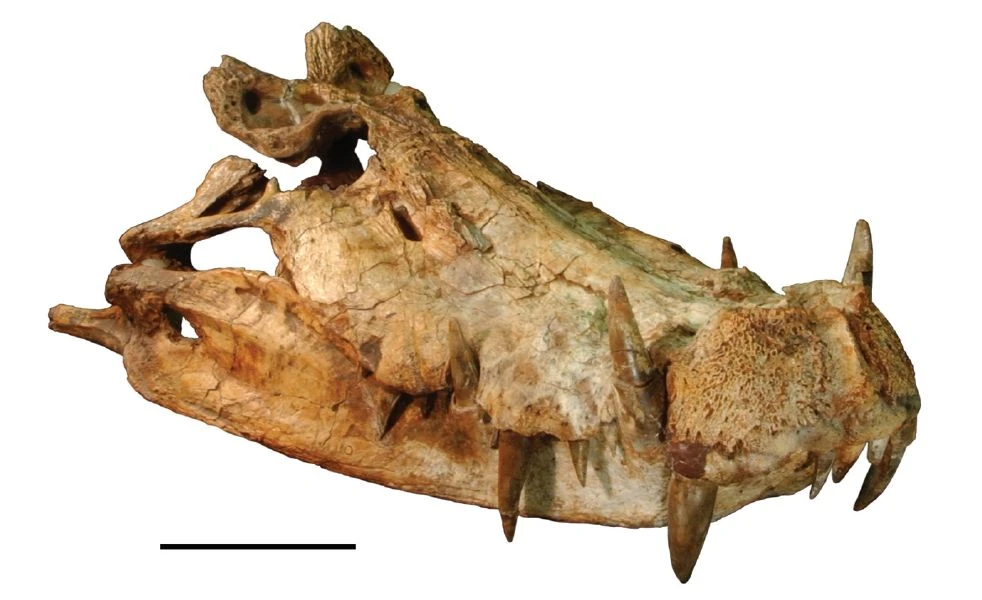
 

Kaprosuchus saharicus
One of the most fascinating fauna however, that lived along side Spinosaurus were the crocodylomorphs. Crocodylomorph diversity was astounding in that area. Recently, an excellent paper was published by Paul Sereno of the University of Chicago, Illinios describing several crocodilians that he and his team had found in North Africa. Crocodilians in North Africa included Sarcosuchus imperator a very crocodylian like animal that was huge and probably fed on large dinosaurs, the "boar-croc" Kaprosuchus saharicus, the flat snouted Stomatosuchus inermis, the duck-billed croc Anatosuchus minor, the "rat-croc" Araripesuchus wegeneri, and another flat-snouted croc Laganosuchus thaumastos. The diversity of crocydilians today are only a small window into the amazing diversity of the crocodilians of the past. Crocodilians were not primarily amphibious, many were either fully marine or fully terrestrial. Some had mammal-like heterodonty complete with incisors, canines, and molars. Others were upright quadrupeds like dogs, and others had skulls that resembled theropod skulls more than crocodylian skulls. What is probably the most amazing is that many crocodilians might have been warm-blooded! How ever you saw crocodylians before, you must change it now! North Africa is an excellent example of that diversity of crocodylomorphs.

What I find interesting is that it seems that there weren't very many small dinosaurs. I think that it would be safe to assume that many trophic levels that small dinosaurs would normally fill were taken over by crocodylamorphs. In other words, the dinosaurs were like the lions and elephants of North Africa but the crocodylomorphs were the jackals and deer equivalents. One of these days I will do a post on crocodilians.

As I hope you can see, the North Africa ecosystem that Spinosaurus lived in was one of the most unique on all earth and perhaps the most dangerous ever as well. From several giant and unique species of dinosaurs, including several huge theropods, just as unique and large fish, and downright bizarre crocs, we would have been quite uncomfortable in that part of the world. And it is amazing that North Africa today is mostly a barren desert!

The diet of Spinosaurus would have been mostly fish but it is possible that Spinosaurus may have been somewhat opportunistic. Other spinosaurs from other parts of the earth showed evidence for feeding on a variety of animals. In Brazil a pterosaur bone was found with a spinosaur tooth embedded in it. When Baryonyx walkeri was found in England not only were partially digested fish scales found in its stomach region but also bones of a juvenile Iguanodon. These finds demonstrate that spinosaurs were not completely limited to piscivory. They evidently fed on other animals enough for it to be recorded in the fossil record. I do not believe that the mammoth Spinosaurus would have been an exception.

Spinosaurus probably hunting sticking it's snout into the water waiting for a fish to come by. It probably swam quite frequently while hunting even. Spinosaurus had several pits on its snout especially along its mouth. These pits were probably similar to what is found in crocodylians that are pressure sensitive thus sensitive to water movement. This would help it locate prey under the water surface.

So what was that large sail on its back even used for? There have been many suggestions. They have included that it acted as an aid in thermoregulation. If dinosaurs were warm-blooded then such a large sail probably would not have been that necessary. Still warm-blooded animals today often use oversize body parts to help regulate their body temperature. An example would be elephant ears. They both help cool and warm up the body of an elephant due to the many capillaries found in their ears. As blood flows through the capillaries in those big ears it is better exposed to the outside temperature, that encourages thermo-exchange. Ears on desert species such as jackels and hares also work the same way. It seems to me however that endothermic animals with such appendages live in dry, hot habitats. Spinosaurus definitely lived in a hot environment but it was not dry. Also lately, it has been argued that the sail would have not had enough blood flow to allow it to be effective. I wouldn't completely write it off however.

Another suggestion is that the sail would have been anchors for exaggerated muscles and lipid storage similar to high withered mammals. That may be possible yet some have argued that the spines lack muscle scars that characterize neural spines used for the same thing. I think that it is another possible but once again you can't be too sure either way.
Bison skeleton
Horse skeleton


Camel skeleton. Note the dorsal vertebra neural spines of these three photos.

Another suggestion is that it was used as a display device, breeding or otherwise. This is possible and it seems to be somewhat accepted more confidently than the rest of the suggestions. If this is true then Spinosaurus would have had the biggest and most extreme display devices of any dinosaur. It may have been similar to deer antlers or peacock feathers. The male with the biggest and most colorful sail proves himself to be bigger and better than all the other guys, as consequence his genes are the ones that are passed to the next generation. Also it may have been similar to frilled lizard frill, used to intimidate other animals that may harm it.

Late in the year 2014 a paper was published in the journal Nature that described new spinosaur material that was found in Morocco by a scientist by the name of Nizar Ibrahim. It was attributed to Spinosaurus aegyptiacus and any material attributed to Spinosaurus is very significant, this was no exception. It is possibly a significant find among significant finds.

Ernest Stromer's original material lacked any appendicular skeletal element, in other words it had no arms or leg bones found with it. Naturally, everybody assumed that Spinosaurus had a similar body plan as every other theropod out there. Of the most complete spinosaurs found they all had "normal" limb proportion. Spinosaurus has always assumed to hve looked like most other large-bodied dinosaur predators once you get past the large sail and the head and neck.

Nizar Ibrahim's limb elements that he found, specifically the hindlimbs, indicated that Spinosaurus was more designed for a semi-aquatic life than what was previously thought and would have been an obligated quadraped when traveling on land. Theories that Spinosaurus could walk on all fours at times had floated around before and studies have shown that Spinosaurus's life revolved around water a great deal but what made this find different was that it asserted that the hindlimbs of Spinosaurus was greatly reduced. It would have looked like some of the upright walking crocodylomorphs that it lived with. This was a radical new idea for this would be the first theropod found that was an obligated quadruped and it would be the first dinosaur discovered that may have been mostly water going.

How Nizar Ibrahim found his skeleton is a very interesting story. The combined stories of how this skeleton was found and how the original was found and lost makes one of the best paleontological bed-time stories in the history of the science. Nizar Ibrahim has done much study on the vertebrate assemblages of Morocco, himself being part Morocco and he had a very keen interest in Ernst Stromer, himself being part German as well. While in Morocco Ibrahim was offered a few bones by a local fossil dealer. He did not think much of them but he thought that they may prove to be important one day and may be a good way to start building his institution's fossil collection. He thought little of them for a few years. After a few years past, Ibrahim was invited by an Italian colleague of his to come to Italy and see some bones that were discovered in a collection that proved to be from Spinosaurus. When Ibrahim saw the bones a few details about the bones caught his eye. It seemed to him that he had seen something similar before. He then remembered the few bones that he had bought from the fossil collector in Morocco. They were Spinosaurus bones! He figured that the bones that he purchased from the man and the bones in the Italian collection was from the same animal and that there might be more. They also needed to find out where the bones were found to better understand the rocks around the specimen.

The solution was a simple one... not really... Ibrahim did not who the name of the man that gave him the bones and all that he could remember was a vague description of the man as having a mustache and being dressed in white clothes. Of course there are only a handful of people in Morocco that would fit that description and the search for that man would be somewhat easy... Of course I am joking. There are thousands of people in Morocco like that. But Ibrahim decided to search for him anyways. He and some colleagues went around the Sahara desert looking for fossil collectors that fit the description and never did find the man they were looking for. They were finally about to give up there search and were having tea in a town. As they were sitting there Ibrahim notices a man walking by who had a beard. He realized that he was his man!

They caught up to the man and the man admitted that he had sold the bones to Ibrahim and had sold the bones that ended up in Italy. He also admitted that they were both from the same animal. The fossil collector was hesitant to give anymore information because selling important finds is illegal. In the end they were able to convince him to show the sight where he had found the bones. The area was combed for more bones and it was thoroughly researched.

That story, combined with Ernst Stromer's story really is a unique and amazing story in the history of paleontology. But paleontology is not limited to good stories.


So far, I personally object with the 2014 reconstruction. First I will have to confess that some of my motives for disagreeing is somewhat subjective. It is hard to see what is probably my favorite dinosaur of all time, the biggest predator of all time, and such a symbol of power and size, humbled to look like a weird, over-glorified wiener dog with big teeth. Almost as soon as the paper was published it gained quite a bit of criticism from other dinosaur workers. That either goes to show that there is something wrong with the methods applied or it showed that Spinosaurus was a favorite dinosaur among many; maybe it is both... Who couldn't love the giant, mysterious monster that dwarfed T. rex and who wouldn't object to turning it into a waddling wiener duck!

I think however that the criticism is relevant and notable individuals have objected to the reconstructions. Scott Hartman was one of the first to say something. He is an expert at making dinosaur skeletal drawings. He is only equalled by Gregory S. Paul in that regards. He knows a thing or two about reconstructing a dinosaur's osteological anatomy. He wrote a number of blog posts on his website critiquing the paper. I would recommend anybody to read the whole series of posts written about the issue. Others have also said something about the reconstruction. Many of the objections are about technical details that are very important. The general consensus is that the material needs to be better described and that more material needs to be found. I would agree.

2014 Ibrahim reconstruction.
Some of my objections is ecological in nature. The new reconstruction just makes little sense to me ecologically! What good would it be for Spinosaurus to have shortened hindlimbs? None in my estimation. The only way it may have benefited Spinosaurus would be if it spent much time in open and deep water. They would be better designed for swimming. However Spinosaurus may not have been able to submerge itself. Why not? Because of its large sail on it back. It would have had no control over itself because the sail would be caught by the current. It could have just floated there but it would have been severely limited in its ability to catch prey. Shortened limbs are not advantageous if an animal is a wader, for that is the next option. Waders are typically long limbed. Take herons and cranes for example. They are waders yet they are quite long limbed. They also have long necks and a long mouth. Spinosaurus also had a long neck and jaws just like a crane. Also I would suggest that Spinosaurus would have been quite vulnerable on land. It would have had a hard time moving around comfortably because it was so front heavy. Anything could have attacked and might have had a chance to overpower it! I do not see how the shortened hind-limbs would have been much benefit. And there lacks any modern equivalent. No open water swimmers are like it and no waders are like it.
Original reconstruction


So anyways, that is my two cents about the matter. I recommend others to study it themselves. Here is a link to the actual paper.

Hopefully I have done a decent job doing Spinosaurus justice. All things considered, Spinosaurus is amazing! It is truly one of the most spectacular dinosaurs ever discovered and has one of the most interesting histories behind its discoveries. However the story is not done and we wait eagerly for it to continue.


 An interesting video about Spinosaurus from BBC's Planet Dinosaur.

Thursday, October 8, 2015

Fascinating New Research On Pterosaurs

Want a break from the shark themed post of late? Neither do I but pterosaurs are a worthy group, anything else just wouldn't do.

Dr. David Hone is a name that any vertebrate paleontologist should be familiar with, especially to those who have an interest in archosaurs. He has recently released a paper discussing something that I have wonder at time about myself. That the wing tips of pterosaurs. Most reconstructions that people see of the wing tips of pterosaurs portrays them as straight yet there is much fossil evidence that pterosaurs would have had wing tips that were naturally bent or curved but also were compliant. That would mean that pterosaurs could have controlled the shape of their wing tips in flight and could therefore would have more control in flight. That concept is a very intriguing one, birds today do not have the same control over their wings that pterosaurs seem to have had.

Dr. Dave Hone gives a quick review of the paper at his blog, Archosaur Musing. Here is the link that he gives for the paper. You can read the paper yourself to see what kind of conclusion he and the co-authors of the paper reached. Tell me what you think.

Bellubrunnus which is an animal that the paper focuses on. Notice the curvature of the distal-most wing phalanges.

Sunday, May 3, 2015

Dunkleosteus: If Super-Man Was a Fish W.P.A. # 3

How about a fish with super strength and could deflect bullets? That is kind of incredible but with one of the most powerful bites in the animal kingdom and with massive body armor, Dunkleosteus terrelli may have fit the boot (but maybe not the tights) quite well. Now I doubt that it could also fly and shoot lasers out of its eyeballs but what fish can? And it definitely did not come from outer-space!

As I said Dunkleosteus was not from outer-space but is actually the famous fossil found in the Cleveland shale in Ohio. Many interesting fossils have been found in that locality but Dunkleosteus is definitely a highlight for obvious reasons. Between its fearsome appearance and large size, estimates putting it at 30 feet (10 meters) long and weighing up to 4 tons, it does not fail to arrest our awe and interest.

One glance of this animals reveals its predatory nature
Dunkleosteus was the largest member of group of fishes known as "Placoderms." Placoderms were a very diverse and unique group of fishes that all had body armor and many had no scales. They came in many different shapes and sizes while filling numerous ecological niches.The one that we will be mainly interested in will be the large, pelagic predator, Dunkleosteus. Pelagic, in this use, refers to an animal that lives above the ocean floor or far from shallows. Basically, they are not benthic or living near the bottom of the body of water. Dunkleosteus was in fact not benthic as some have asserted. They were free-swimming fishes. They also were predatory which is no surprise to any casual observer. The designs that are part of their predatory life-style are quite amazing.

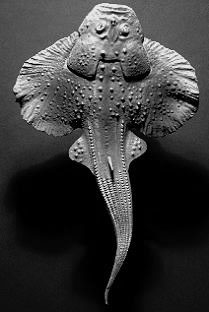
You may have come to the conclusion that this is an Elasmobranch of the skate or ray family
but this is actually a Placoderm.
It is an example of a benthic organism.
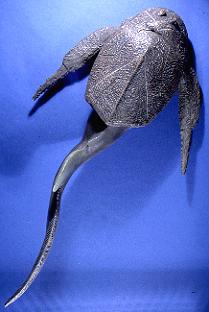
Another example of the intriguing diversity of Placoderms.
 This also was a benthic animal, using its pectoral fins as aids in locomotion.
 Some scientists have described Dunkleosteus as being an "anguilliform" swimmer. That basically means that Dunkleosteus would have swam like an eel (anguilla is Latin for "eel," form means exactly what it sounds like). Unfortunately that is a rather inefficient way of swimming for a pelagic fish that is also a hunter for it is a slow and clumsy way to go. It works great for eels though. Remember what I said in my last W.P.A. post about scientists and their pessimism? Dunkleosteus though in my opinion, as well as others' opinions (which are worth more than mine) may have been a "subcarangiform" swimmer or even a "carangiform" which are more efficient swimming styles. I wouldn't be surprised if Dunkleosteus would turn out to be a full "carangiform" swimmer. Being a subcarangiform or a carangiform swimmer would be more efficient for a predator to be a predator.  

Does that mean that Dunkleosteus was faster than a swimming bullet? Probably not, it was still a very large and heavy animal (you try swimming while wearing heavy armor). Many of the animals that it hunted, however, may have been quite agile. That leads to a rather obvious dilemma. This is probably the cause of Dunkleosteus extinction... Just kidding! As we shall see Dunkleosteus was not without an answer to this problem.


Ascertaining the biomechanics of an extinct animal is a great way to better understand how the animal would have live. Biomechanics is the study of how living organisms operate mechanically. Dunkleosteus is a wonderful example of how biomechanics help us understand an extinct animal. The mechanics of how Dunkleosteus opened its mouth helps us understand how it would have hunted and what it would have hunted. What the biomechanics indicate is that Dunkleosteus may have used suction for capturing prey. Suction feeding is not an uncommon hunting technique in fishes today. As illustrated in the below videos, it a very useful skill for an aquatic predator to have. 


OK the first two have scientific interest but, though it is not much for scientific use, I had to add this rather amusing video...


As you can see suction feeding is an effective feeding strategy. A tell-tale characteristic of a suction feeder is the ability to open the mouth very quickly. The speed at which Dunkleosteus has been estimated to open its mouth is between the fastest-suction feeders (like the ones in the videos) and the nurse shark, well within range to be an effective suction feeder. There are soft-tissue morphology that would need to present if Dunkleosteus could have suction fed but the soft tissue is not known in this fish, therefore we can only infer that Dunkleosteus could have suction fed by how the jaws were designed but we will never be 100% confident. 

How the jaws of Dunkleosteus worked is very intriguing. There was a gap between the cranium and the thoracic shield which is the body armor behind the head. That gap housed a muscle and muscles can only contract. Take a moment right now and move your arm around. All of those movements that you just did happened because a muscle or a group of muscles contracted. When the muscle that was in that gap between the cranium and thoracic shield of Dunkleosteus, called the nuchal gap, contracted it lifted the upper jaws. There was another muscle that connected the head to the thoracic shield that also assisted with lifting the cranium. The muscles that connected the lower jaw with the bottom of the thoracic shield also contracted at the same time. This caused the mouth to open and based on the size of of those muscles and other factors that would effect performance, it has been estimated that Dunkleosteus could have opened its mouth around 60 milliseconds. This is what is necessary for suction-feeding.


Dunkleosteus may have also had the strongest bite of any fish that has been measured. It has been predicted that the great white shark may have had the strongest bite of any animal alive today but it has never actually been measured. The bite force of Dunkleosteus may have been around 7000 to 6000 newtons. That is a lot of pressure. And the way that Dunkleosteus was designed it would have chomped down at lightning quick speeds, perhaps as fast as it could open its mouth. Crocodylians have the strongest bite force ever measured of an animals alive today at 13000 N (yes you read that right 13,000 N!). Now this is not a post about how AWESOME crocodylians are but consider that the fish that was much bigger than any living crocodile and may have the highest bite force of any fish measured is only around half that of an extant crocodile! Now imagine an extinct crocodylian as big as a school bus! Crocodylians will definitely be a future post for it is not just their bites that are amazing.

OK so back to Dunkleosteus. Now the bite of this fish was around 6000 to 7000 N, hyenas that brake bones with their teeth only have a bite force a little less than 5000 N. The mechanics of their jaws is what helps them achieve such large bite strength. If you have familiarity you with egineering or mechanics, will recognize the mechanical system of Dunkleosteus' jaws as a form of the four-bar linkage system which is a system that is used extensively in both man-made objects as well as in the natural world. Below is a video of how Dunkleosteus' jaw may have worked: 


The teeth, or blades rather, of Dunkleosteus was well designed for crushing shells and body armor while cleanly slicing flesh. What that may indicate is that while Dunkleosteus had slicing gear that was effective for crushing animals with body armor such as ammonoids and other placoderms it would have been a very efficient killer of sharks and other soft bodied animals as well. The blades within the mouth of Dunkleosteus allow for a bite that would require as little energy as possible to cleanly brake through hard armor while slicing flesh, basically doing more for less. The strength of its jaws was joined with the design of its blades maximizing its bites effectiveness. This also indicates that it would not swallow prey and its prey may even be quite large making it too big to swallow whole anyways.

Time for some myth-busting. Did you know that you have been misinformed your whole life? That is correct, you have not been told the whole truth about placoderms your entire life. The truth about placoderms is this: they did not have lungs.  That is probably earth shattering for you but it is the truth. Next time you hear that bit of mistruth that placoderms did have lungs being repeated then you will now know that it is not accurate. It was a myth started by Robert Denison, then young researcher, in the early 1900s. A more recent look into his description of the specimen that Denison was describing as well as studying the fossils themselves has revealed the mistake. Unfortunately, that was done after the myth was repeated by many mainstream encyclopedias such as the Encyclopedia brittanica and many texts books. Well now you can rest assured that you know the truth about placoderm respiration and now can correct all those you meet so that they too may know that placoderms did not have lungs.

In my opinion this has been an interesting study in the biology and a little ecology of Dunkleosteus. What is interesting is that all that has been revealed about Dunkleosteus has come from studying the anterior part of its body as well as comparing Dunkleosteus with other placoderms. Beyond the head and thoracic shield, no other part of Dunkleosteus has been discovered. Who knows what other interesting facts about this amazing animal we will be to discover if more fossils are found.