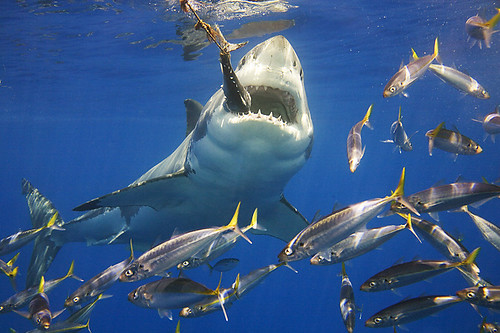
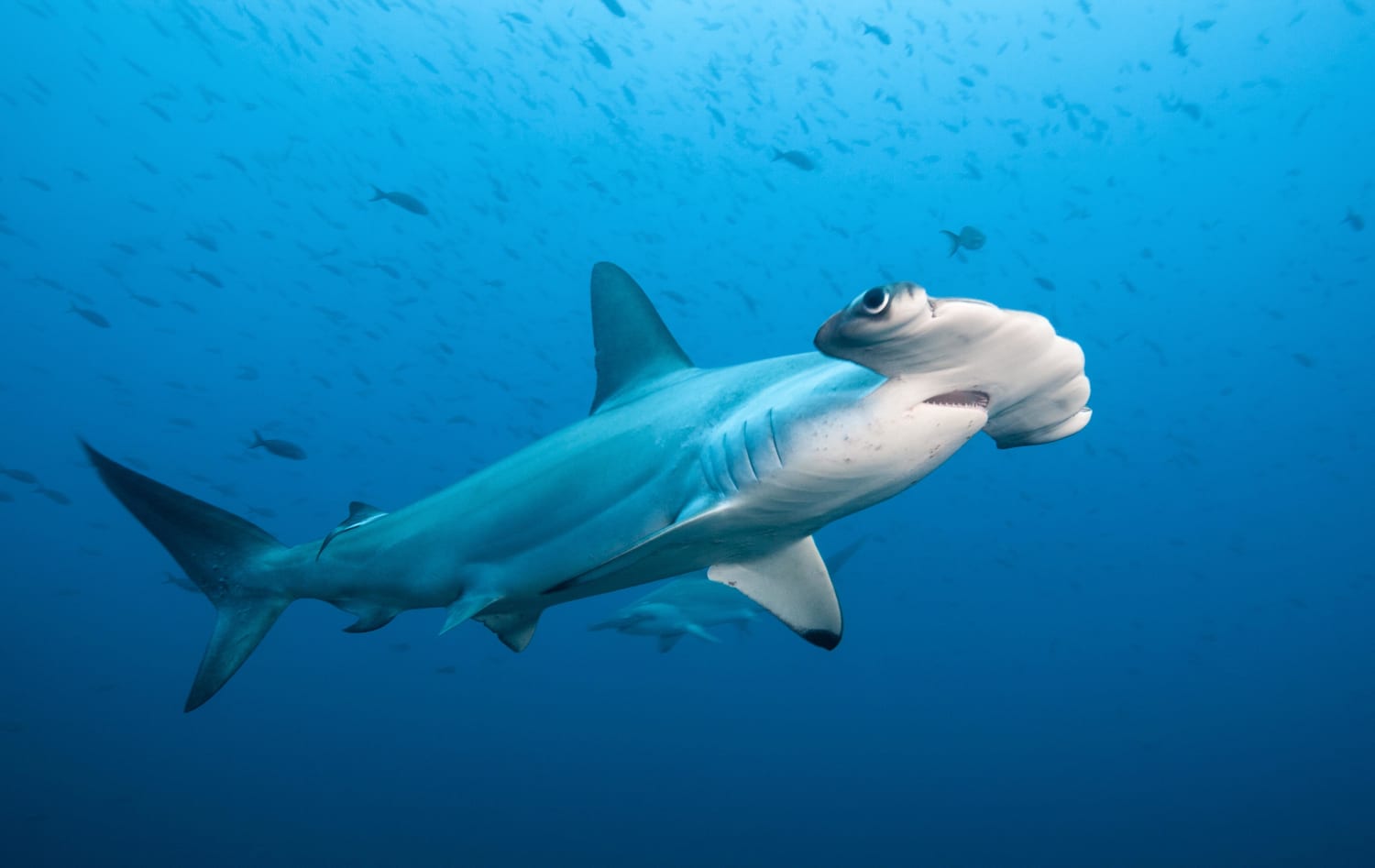
An illness is going through our family lately and a few of the younger members of the household have rapidly eject their gastric contents several times. I haven't done that for several years now and hope to keep it that way. But do you know what is probably the first thing that I think when someone rapidly eject their gastric contents? "I sure hope this will be easy to clean-up..." but after that I do some more considerate thinking, "you know, when sharks throw-up they regurgitate their stomachs as well." Sometimes I speak my mind but few are amused, particularly the sick person.
But anyways, sharks and "stomach eversion," as it is properly called, has been on my mind today and I thought I might share with you an intriguing video of stomach eversion in action. Below is a rather fascinating video of a short fin mako (Isurus oxyrinchus) regurgitating its own stomach. Why they regurgitate their stomach will have to be for a future post but for now enjoy the video and maybe do some research on your own, it will give you something interesting to think about when you are under the weather.
Did you know that shark skin acts like an exoskeleton and is covered with teeth from nose to tail? I am preparing a review of my newest addition to my growing library: the Biology of Sharks and Rays, by A. Peter Klimly. Also I am chewing on doing a post on Abelisaurs.
How about a fish with super strength and could deflect bullets? That
is kind of incredible but with one of the most powerful bites in the
animal kingdom and with massive body armor, Dunkleosteus terrelli may
have fit the boot (but maybe not the tights) quite well. Now I doubt
that it could also fly and shoot lasers out of its eyeballs but what
fish can? And it definitely did not come from outer-space!
As I said Dunkleosteus was not from outer-space but is actually the famous fossil found in the Cleveland shale in Ohio. Many interesting fossils have been found in that locality but Dunkleosteus is definitely a highlight for obvious reasons. Between its fearsome appearance and large size, estimates putting it at 30 feet (10 meters) long and weighing up to 4 tons, it does not fail to arrest our awe and interest.
One glance of this animals reveals its predatory nature
Dunkleosteus was the largest member of group
of fishes known as "Placoderms." Placoderms were a very diverse and
unique group of fishes that all had body armor and many had no scales.
They came in many different shapes and sizes while filling numerous
ecological niches.The one that we will be mainly interested in will be
the large, pelagic predator, Dunkleosteus. Pelagic, in this use,
refers to an animal that lives above the ocean floor or far from
shallows. Basically, they are not benthic or living near the bottom of
the body of water. Dunkleosteus was in fact not benthic as some
have asserted. They were free-swimming fishes. They also were predatory
which is no surprise to any casual observer. The designs that are
part of their predatory life-style are quite amazing.
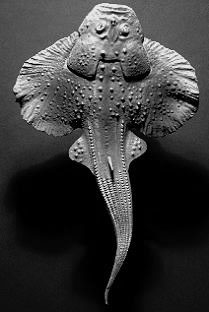
You may have come to the conclusion that this is an Elasmobranch of the skate or ray family
but this is actually a Placoderm.
It is an example of a benthic organism.
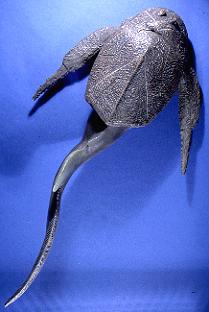
Another example of the intriguing diversity of Placoderms.
This also was a benthic animal, using its pectoral fins as aids in locomotion.
Some scientists have described Dunkleosteus as being an "anguilliform" swimmer. That basically means that Dunkleosteus would have swam like an eel (anguilla is Latin for "eel," form means
exactly what it sounds like). Unfortunately that is a rather
inefficient way of swimming for a pelagic fish that is also a hunter for
it is a slow and clumsy way to go. It works great for eels though.Remember what I said in my last W.P.A. post about scientists and their pessimism?Dunkleosteus though
in my opinion, as well as others' opinions (which are worth more than mine) may
have been a "subcarangiform" swimmer or even a "carangiform" which are
more efficient swimming styles. I wouldn't be surprised if Dunkleosteus would
turn out to be a full "carangiform" swimmer. Being a subcarangiform or a
carangiform swimmer would be more efficient for a predator to be a
predator.
Does that mean that Dunkleosteus was
faster than a swimming bullet? Probably not, it was still a very large
and heavy animal (you try swimming while wearing heavy armor). Many of
the animals that it hunted, however, may have been quite agile. That
leads to a rather obvious dilemma. This is probably the cause of Dunkleosteus extinction... Just kidding! As we shall see Dunkleosteus was not without an answer to this problem.
Ascertaining the biomechanics of an extinct animal is a great way to better understand how the animal would have live. Biomechanics is the study of how living organisms operate mechanically. Dunkleosteus is a wonderful example of how biomechanics help us understand an extinct animal. The mechanics of how Dunkleosteus opened its mouth helps us understand how it would have hunted and what it would have hunted. What the biomechanics indicate is that Dunkleosteus may have used suction for capturing prey. Suction feeding is not an uncommon hunting technique in fishes today. As illustrated in the below videos, it a very useful skill for an aquatic predator to have.
OK the first two have scientific interest but, though it is not much for scientific use, I had to add this rather amusing video...
As you can see suction feeding is an effective feeding strategy. A tell-tale characteristic of a suction feeder is the ability to open the mouth very quickly. The speed at which Dunkleosteus has been estimated to open its mouth is between the fastest-suction feeders (like the ones in the videos) and the nurse shark, well within range to be an effective suction feeder. There are soft-tissue morphology that would need to present if Dunkleosteus could have suction fed but the soft tissue is not known in this fish, therefore we can only infer that Dunkleosteus could have suction fed by how the jaws were designed but we will never be 100% confident.
How the jaws of Dunkleosteus worked is very intriguing. There was a gap between the cranium and the thoracic shield which is the body armor behind the head. That gap housed a muscle and muscles can only contract. Take a moment right now and move your arm around. All of those movements that you just did happened because a muscle or a group of muscles contracted. When the muscle that was in that gap between the cranium and thoracic shield of Dunkleosteus, called the nuchal gap, contracted it lifted the upper jaws. There was another muscle that connected the head to the thoracic shield that also assisted with lifting the cranium. The muscles that connected the lower jaw with the bottom of the thoracic shield also contracted at the same time. This caused the mouth to open and based on the size of of those muscles and other factors that would effect performance, it has been estimated that Dunkleosteus could have opened its mouth around 60 milliseconds. This is what is necessary for suction-feeding.
Dunkleosteus may have also had the strongest bite of any fish that has been measured. It has been predicted that the great white shark may have had the strongest bite of any animal alive today but it has never actually been measured. The bite force of Dunkleosteus may have been around 7000 to 6000 newtons. That is a lot of pressure. And the way that Dunkleosteus was designed it would have chomped down at lightning quick speeds, perhaps as fast as it could open its mouth. Crocodylians have the strongest bite force ever measured of an animals alive today at 13000 N (yes you read that right 13,000 N!). Now this is not a post about how AWESOME crocodylians are but consider that the fish that was much bigger than any living crocodile and may have the highest bite force of any fish measured is only around half that of an extant crocodile! Now imagine an extinct crocodylian as big as a school bus! Crocodylians will definitely be a future post for it is not just their bites that are amazing.
OK so back to Dunkleosteus. Now the bite of this fish was around 6000 to 7000 N, hyenas that brake bones with their teeth only have a bite force a little less than 5000 N. The mechanics of their jaws is what helps them achieve such large bite strength. If you have familiarity you with egineering or mechanics, will recognize the mechanical system of Dunkleosteus' jaws as a form of the four-bar linkage system which is a system that is used extensively in both man-made objects as well as in the natural world. Below is a video of how Dunkleosteus' jaw may have worked:
The teeth, or blades rather, of Dunkleosteus was well designed for crushing shells and body armor while cleanly slicing flesh. What that may indicate is that while Dunkleosteus had slicing gear that was effective for crushing animals with body armor such as ammonoids and other placoderms it would have been a very efficient killer of sharks and other soft bodied animals as well. The blades within the mouth of Dunkleosteus allow for a bite that would require as little energy as possible to cleanly brake through hard armor while slicing flesh, basically doing more for less. The strength of its jaws was joined with the design of its blades maximizing its bites effectiveness. This also indicates that it would not swallow prey and its prey may even be quite large making it too big to swallow whole anyways.
Time for some myth-busting. Did you know that you have been misinformed your whole life? That is correct, you have not been told the whole truth about placoderms your entire life. The truth about placoderms is this: they did not have lungs. That is probably earth shattering for you but it is the truth. Next time you hear that bit of mistruth that placoderms did have lungs being repeated then you will now know that it is not accurate. It was a myth started by Robert Denison, then young researcher, in the early 1900s. A more recent look into his description of the specimen that Denison was describing as well as studying the fossils themselves has revealed the mistake. Unfortunately, that was done after the myth was repeated by many mainstream encyclopedias such as the Encyclopedia brittanica and many texts books. Well now you can rest assured that you know the truth about placoderm respiration and now can correct all those you meet so that they too may know that placoderms did not have lungs.
In my opinion this has been an interesting study in the biology and a little ecology of Dunkleosteus. What is interesting is that all that has been revealed about Dunkleosteus has come from studying the anterior part of its body as well as comparing Dunkleosteus with other placoderms. Beyond the head and thoracic shield, no other part of Dunkleosteus has been discovered. Who knows what other interesting facts about this amazing animal we will be to discover if more fossils are found.
Sharks cause much fear from people. The word shark is synonymous with a killer. Perhaps this reputation isn't completely unfounded but perhaps it is a little exaggerated. Man's fear of sharks really hasn't been around that long, only a century. If I may point out that crocodiles don't have such a strong reputation for killing people yet they kill more people a year than sharks do. That could be because there hasn't been a killer crocodile blockbuster movie made and also because most people that conflict with crocodylians are people living in third world countries. More Americans conflict with sharks than with crocodiles. One of these days I will write on some of my favorite animals, the crocodylians. Right now I will be writing on a fascinating specie of shark Charcharhinus leucas also known as the bull shark.
The bull shark is found in all warm and shallow seas around the world and they can even spend much of their life in a freshwater environment. They will swim up-rivers and can potential spend their entire lives in a river or lake. Estuaries and semi-saline waters are often used as nurseries for the bull shark. This is a very unique ability for a shark and they have been found remarkable distances from the ocean. The farthest up river that they have been found was 2,500 miles up the Amazon river! One that hits a little closer to home is that a bull shark was accidentally caught by commercial fishermen in the Mississippi river in Illinois, just a few miles north of St. Louis, Missouri. That was 1,750 miles from the Gulf of Mexico! You can read more about this interesting catch here. This cannot happen anymore, sadly, for dams have been built along the river causing passage that far up the Mississippi impossible for a shark.
In case you haven't noticed, that the places that the bull shark likes to swim is also where people like to swim.They are also extremely territorial and aggressive. This has caused many attacks and the bull shark had been labelled the third most dangerous shark to humans. They are probably responsible for more attacks than what has been attributed to them due to misidentification. The bull shark's range also matches with the most dangerous and second most dangerous sharks, the great white and tiger sharks, and they look similar to both. This encourages misidentification.
The bull shark was also probably one of the sharks involved with the 1916 New Jersey sharks attacks. This event was the inspiration for the movie Jaws and for good reason. Within two weeks, four people died due to a shark attack and one was injured. My theory is that there were only two sharks involved, one great white shark and a bull shark. The whole story of the attacks sounds like something from a fiction story and is quite fascinating.
Bull sharks can get pretty big reaching a length of 13 feet and weighing as much as 500 lbs. The females are usually larger than males.
The bull shark is an opportunistic feeder, eating whatever it can whenever it can. They will even eat smaller member of their own species. Sometimes they will eat bright pieces of litter such as cans and coins. This can cause hazards to the shark so don't litter, even if you live in Montana, because you might hurt a shark... Bull sharks use a unique killing method to bring down their prey. They will circle their prey and bump it with their nose which disorients their prey and can even kill their prey.
Their predators are naturally only what is bigger than they are. Great white sharks and tiger sharks are what they mainly need to be afraid of. Man often kills bull sharks as well. Due to their affinity to fresh-water and shallow seas, they will come in conflict with a crocodile with an affinity for salt-water. As you can see, the bull shark is on the losing side of the bargain.
Sharks are amazing creatures. There is an incredible variety of sharks throughout the world and the bull shark is one of them. The bull shark is definitely a fascinating creature.